
Foil Stamping Misregistration: Solving Edge Alignment on Pouch Lines
Foil decoration that sits correctly at the start of a roll and drifts off the printed panel by the end of the run is not, in most cases, a printing fault. On a roll-to-roll pouch line it is a reference fault: the film edge moved relative to the stamping unit, or the stamping unit stayed fixed while the pouch format changed. Correcting one of those two conditions does not stop the drift.
This guide covers the two-part control used on the digital stamping machine specified here — a rewind edge alignment tolerance of ≤2 mm, which bounds how far the web edge may travel, and a laterally adjustable foil stamping unit with 420 mm foil width and a 1000 mm lateral adjustment range, which repositions the decoration lane without mechanical changeover. It also covers the operating envelope of 30–50 m/min line speed and 30–100 strokes/min stamping speed, and the switch between cold foil stamping, spot UV and embossing-debossing on the same unit.
It is written for medium and large flexible packaging factories running diversified pouch output — flat bottom with zipper, stand-up with zipper, doypack, central seal, valve pouch, bag-in-box and in-line labelled bags — and for the line engineers who have to move that output through several decoration jobs inside one shift.
Misregistration on a pouch line is two faults, not one
Misregistration presents as a single symptom — foil sitting left, right, forward or back of where the artwork expects it — but it originates in two independent faults that need separate correction.
Lateral edge drift. The web edge position at the unwind or rewind changes during the run. Every station that references that edge — print register, the stamping lane, the die-cut station, slitting — shifts with it. The tell is that the stamped image keeps its position relative to the printed artwork while both move relative to the web edge and the finished seal line.
Longitudinal step error. The foil advance per machine cycle does not match the web advance per cycle at the speed the line is running. The tell here is different: the offset repeats every cycle at a similar magnitude, from the first pouch of the roll to the last.
The complication is that the stamping station is rarely the station that reports the fault. The defect usually surfaces downstream, at die-cutting, at zipper or valve insertion, or at final inspection, by which point the operator is looking at the wrong part of the line.
Why mixed pouch production makes the fault worse
A line that runs one format at one decoration position can hide a weak edge reference for years. A line that runs a mixed order book cannot. Each pouch format changes the panel layout and therefore the position of the decoration zone: a flat bottom with zipper bag places the decorated front panel above a formed bottom gusset; a stand-up with zipper bag or a doypack sets decoration against the zipper rail and the bottom curve; a central seal pouch references decoration to the back seal; a valve pouch adds a valve position that the decoration has to clear; bag-in-box work moves the decoration toward the fitment area; label pasting in-line adds one more station between the web and the rewind.
On a stamping head with a fixed lateral position, every one of those changes means mechanical repositioning or new tooling, and each repositioning restarts the registration loop. Add a second variable — the same unit running cold foil stamping, then spot UV, then embossing-debossing for a different customer — and the number of setups per week multiplies faster than the number of orders.
Speed compounds it. At 30 m/min the web advances roughly 500 mm every second; at 50 m/min, roughly 833 mm every second. At 100 strokes/min the head fires once every 600 ms. A lateral or longitudinal error that is invisible at thread speed becomes a visible offset within a few seconds of production running, because there is simply less time for the web to settle between stations.
What the market signals say about registration pressure
The commercial context behind this problem is a market shifting toward automation and toward formats that are harder to keep in register. Dataintelo values the global bag making machine market at USD 4.8 billion in 2025, with a projection of USD 8.1 billion by 2034, and puts Asia Pacific at a 43.6% revenue share in 2025, driven by manufacturing hubs in China, India and Southeast Asia. The same source reports that automatic bag making machines accounted for 52.4% of global product type share in 2025, reflecting the move toward industrial automation.
Format trends point the same way. Grand View Research reports that the zipper closure segment represented 41.0% of pouch market revenue in 2025, and that flat pouches took the largest revenue share at 63.7%, citing cost efficiency and high-speed production capability. Fortune Business Insights cites sustainability and the shift to mono-material recyclable films as the top drivers for machine upgrades in 2024–2025.
Two of those signals matter directly for registration work. Zipper-heavy output adds stations between the web and the rewind, and each station is one more opportunity for the web to move. Film substitution changes web stiffness and elongation behaviour, which is exactly what an edge-alignment tolerance has to absorb. Treat vendor market figures as scope-dependent rather than absolute: 2025 estimates for this market range from USD 4.8 billion (Dataintelo) to USD 2.8 billion (Market Research Future, under a broader 'bagging machine' definition), so use them for direction only.
Part one of the solution: a bounded edge reference at the rewind
The rewind edge alignment tolerance of ≤2 mm holds the lateral position of the finished roll edge inside a 2 mm band. That sounds like a modest number until you consider what it does for the operator downstream: it converts the web edge into a usable reference.
On an unprinted or partly printed web, the edge is often the only stable datum the stamping station has. If the edge can wander without limit, any lateral correction made at the stamping unit is valid only until the edge moves again, and the operator ends up chasing the web through the roll. If the edge is held inside a bounded band, a lane correction made at the start of the roll stays valid for the run, and the residual error the operator has to work with is known in advance.
In practice the tolerance is best read as an error budget. It tells you how much lateral movement the stamping lane has to tolerate before it becomes visible on the pouch, and therefore how much of the registration problem the line itself has already removed.
Part two of the solution: a laterally adjustable foil stamping unit
The laterally adjustable foil stamping unit removes the second fault by moving the decoration lane instead of rebuilding the head. Its 420 mm foil width defines the decoration width the unit can address in a single pass; its 1000 mm lateral adjustment range defines how far across the web that lane can be repositioned.
For a factory, the operational meaning is straightforward: when the next order uses a different panel layout, the operator moves the stamping unit laterally within the 1000 mm range and re-establishes the reference, rather than carrying out a mechanical changeover. Mixed orders can then be scheduled back to back without a rebuild between them — which is the difference between a line that can accept a diversified order book and one that cannot.
The unit described here is supplied by FOSHANTIANZHENG (Foshan Tianzheng Machinery Co., Ltd.), a flexible-packaging equipment manufacturer founded in 1993, originally as the Hongli bag-making factory, and based in Shunde, Foshan, China, with a 6,000 m² plant and a 15-engineer R&D team. The company states that 87% of components are produced in-house across four CNC machining centres, which is relevant to registration work because lateral adjustment is only repeatable if the frame and slide it sits on are machined to a consistent reference.
Where the specification stops. A 420 mm foil width does not cover decoration wider than 420 mm in a single lane, and a 1000 mm lateral range does not extend beyond 1000 mm. Formats outside those envelopes need a different configuration, not a different setting.
Running three decoration processes on one unit
The same unit handles cold foil stamping, spot UV and embossing-debossing as process changes rather than mechanical changeovers. That is a genuine scheduling advantage for a factory selling decorated pouches into several end markets, but it does not make the three processes interchangeable in verification terms.
Each process produces a different visible result. Cold foil stamping transfers a metallic layer, so the visible outcome depends on where the transferred layer lands. Spot UV applies a registered coating, so misregistration reads as a coating edge that does not follow the artwork. Embossing-debossing deforms the web itself, so misregistration appears as displaced relief rather than a displaced colour.
The practical rule is that a process switch is a process change, not a re-verification exemption. Re-check the edge reference and the lane position after every switch, at the line speed you actually intend to run, because each process puts a different demand on web tension and each one fails differently.
The speed envelope: 30–50 m/min and 30–100 strokes/min
Line speed determines how long the web spends under the stamping head; stroke rate determines how often the head fires. The two have to be set together, because the distance the web travels between strokes is the product of the two. Double the stroke rate while line speed stays constant and the pitch per stroke halves — which is why a registration that holds at one setting fails immediately at another.
The specification here gives a 30–50 m/min line speed range and a 30–100 strokes/min stamping speed range. The useful operating answer usually sits inside both ranges rather than at the top of either, because running at maximum speed and maximum stroke rate together leaves almost no correction margin when film tension shifts.
There is also a scheduling relationship worth checking before the order is quoted. The bag making line itself is specified at 30–130 bags per minute, while the stamping unit runs 30–100 strokes per minute. If only part of the output is decorated, the stamping unit is not necessarily the constraint; if every bag is decorated, the stroke rate caps the decorated output and should be planned against the number of decorated bags required, not against the line's maximum.
A seven-step setup and verification procedure
The following sequence separates the two faults before either is corrected, so that a lateral setting is not used to chase a tension problem.
- Establish the edge reference first. Measure web edge position at the start, middle and end of a full roll. If the edge moves outside the ≤2 mm band, correct web guiding and tension before touching the stamping unit. Adjusting the lane against a moving edge hides the fault and moves it downstream.
- Set tension at production speed, not at thread speed. Registration confirmed at creep speed and then run at 40 m/min is a common source of 'new' misregistration that is not new at all.
- Position the unit laterally. Move the stamping unit within the 1000 mm range so the foil lane aligns with the decoration zone, and confirm that the zone sits inside the 420 mm foil width.
- Match stroke rate to web advance. Set the stroke rate inside 30–100 strokes/min against the planned line speed and repeat length, then run one pitch of waste and measure the stamped position rather than judging it by eye.
- Verify at three points on the roll. Check start, middle and end. A roll that registers at the start and drifts at the end is telling you about edge or tension, not about the stamping head.
- Re-verify after any process switch. Cold foil, spot UV and embossing-debossing each need their own confirmation pass at the intended operating speed.
- Record the setting per format. Log the lateral position and stroke rate for each pouch format so a repeat order starts from a known reference instead of a new guess.
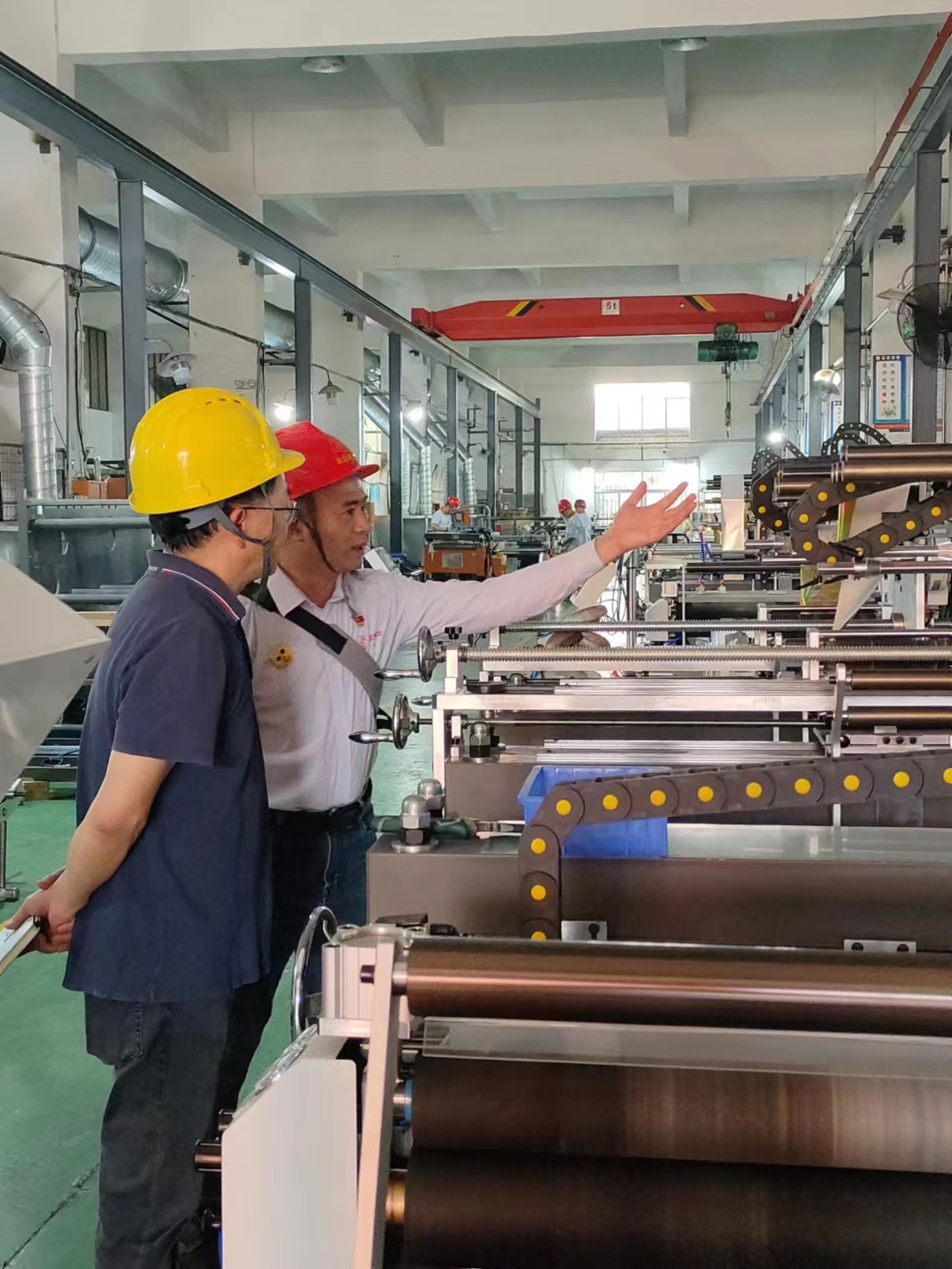
Format, film structure and decoration scope are usually settled in a configuration review before the registration settings are fixed.
Diagnosing drift: symptom, likely cause, first check
Most misregistration complaints on a pouch line fall into one of five patterns. The table below uses the two-part control as the diagnostic frame — edge reference first, lane and stroke rate second.
| Symptom | Likely cause | First check |
|---|---|---|
| Offset drifts progressively in one direction as the roll unwinds | Web edge movement or tension change through the roll | Edge position at start and end of roll against the ≤2 mm band |
| Every pouch carries the same lateral offset | Stamping lane set to the wrong lateral position | Lane position within the 1000 mm adjustment range |
| Offset appears or changes after a speed change | Stroke rate not matched to web advance | Stroke rate against line speed, inside 30–100 strokes/min |
| Offset appears only after a decoration process change | Working position not re-established after the switch | Re-verify lane and edge reference at operating speed |
| Offset appears on one pouch format only | Lateral position not reset when the format changed | Whether that format's decoration zone sits inside the 420 mm width |
Matching the control to specific pouch formats
Registration work changes character with the format, because each format puts the decorated panel in a different relationship to a structural feature — a seal, a zipper, a gusset or a fitment.
- Flat bottom with zipper: decoration sits on a panel that is later formed into a bottom gusset, so lateral drift shows up as decoration skewed relative to the bottom seal rather than as a simple side offset.
- Stand-up with zipper and doypack: the zipper rail and the bottom curve are both visible references on the finished pouch, so decoration is judged against them; a lane position that is acceptable on a flat pouch can look off-centre here.
- Central seal pouch: the back seal defines the pouch's centre line, which makes lateral drift easy to see on both faces at once.
- Valve pouch: the valve position adds a constraint the decoration has to clear, so the usable decoration zone is narrower than the panel itself.
- Bag-in-box: decoration is concentrated near the fitment area on a large-format bag, so a small lateral error is more visible relative to the decorated area.
- Label pasting in-line and zipper pouch formats: the label or zipper station adds one more reference the stamped area must agree with, which makes the edge reference more valuable, not less.
Specification summary
For evaluation purposes, the figures that matter are the ones that define what the line can and cannot do without a mechanical changeover.
| Criterion | Specification | What it controls on the line |
|---|---|---|
| Rewind edge alignment tolerance | ≤2 mm | How far the web edge may move at the rewind — the datum the foil lane is set from |
| Foil stamping unit width | 420 mm | Decoration width addressable in a single lane |
| Lateral adjustment range | 1000 mm | How far the unit can be repositioned across the web without mechanical changeover |
| Decoration processes | Cold foil stamping, spot UV, embossing-debossing | Number of decoration jobs the same line can accept |
| Line speed | 30–50 m/min | Time the web spends under the head per metre of travel |
| Stamping speed | 30–100 strokes/min | How often the head fires; must match web advance per stroke |
| Bag making output | 30–130 bags/min | Output ceiling the decorated volume has to be scheduled against |
| Typical production lead time | 30–45 days | Planning window for a new unit or a changed configuration |
What the specification does not tell you
Four limits are worth stating plainly, because each one is a question a buyer should ask before committing a format to the line.
The edge tolerance is not an image tolerance. ≤2 mm describes edge position at the rewind. The accuracy of the stamped image relative to the printed register mark depends on the web path, the foil feed and the die-cut station as well, and should be confirmed on a trial rather than inferred from the rewind figure.
Lateral range is not decoration width. The 1000 mm adjustment range moves the unit; the 420 mm foil width limits what it can decorate in one lane. A wide-format job can be within the movement range and still outside the decoration width.
Speed ranges are operating ranges, not guarantees. 30–50 m/min and 30–100 strokes/min define where the unit is designed to run. The usable combination for a specific pouch depends on repeat length, film structure and how much correction margin the operator wants to keep in reserve.
No tolerance fixes an unstable unwind. If the film is stretching in tension or the unwind is mechanically inconsistent, the edge will move regardless of what the stamping unit does. That is why the edge check comes first in the setup procedure.
Verifying the supplier and the safety scope
Registration performance is a mechanical outcome, so it is worth checking how the machine is built and how it is guarded, not only what it is specified to do.
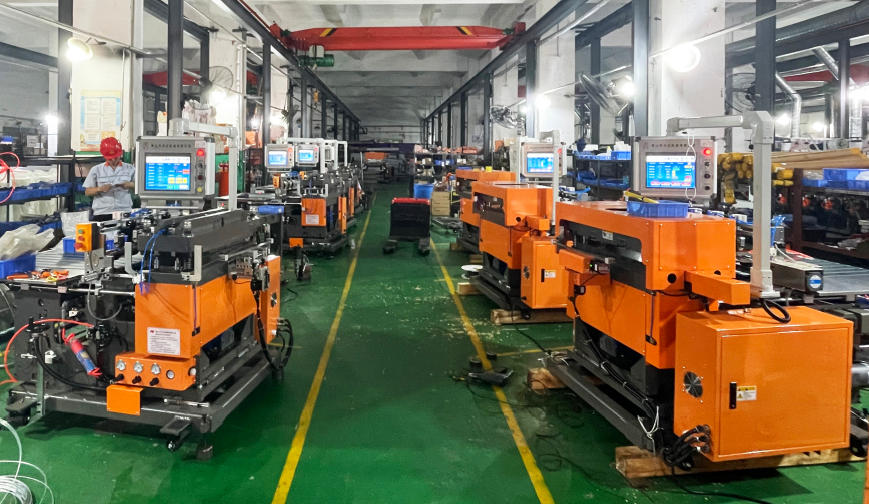
Frame and slide machining consistency directly affects whether a lateral adjustment position repeats from one order to the next.
FOSHANTIANZHENG states that it produces 87% of components in-house using four CNC machining centres, CNC lathes and precision grinding machines — relevant here because a laterally adjustable unit holds its position only if the structure it slides on is machined consistently. The company holds ISO 9001 quality system certification and EU CE certification, and exports to more than 20 countries with a 30% export ratio, participating in packaging exhibitions in Germany, Russia, India, Thailand and Vietnam.
On safety, the documented control for mechanical pinch risk is a safety guard combined with a fault alarm system — the relevant exposure on a stamping and rewind line being the moving head and the roll handling area. For EU-bound machinery, packaging equipment falls under the EN ISO 12100:2010 risk assessment framework and the EN 415 series of Type C standards for packaging machines, so the risk assessment and guard design should be part of the technical file rather than an afterthought at installation.
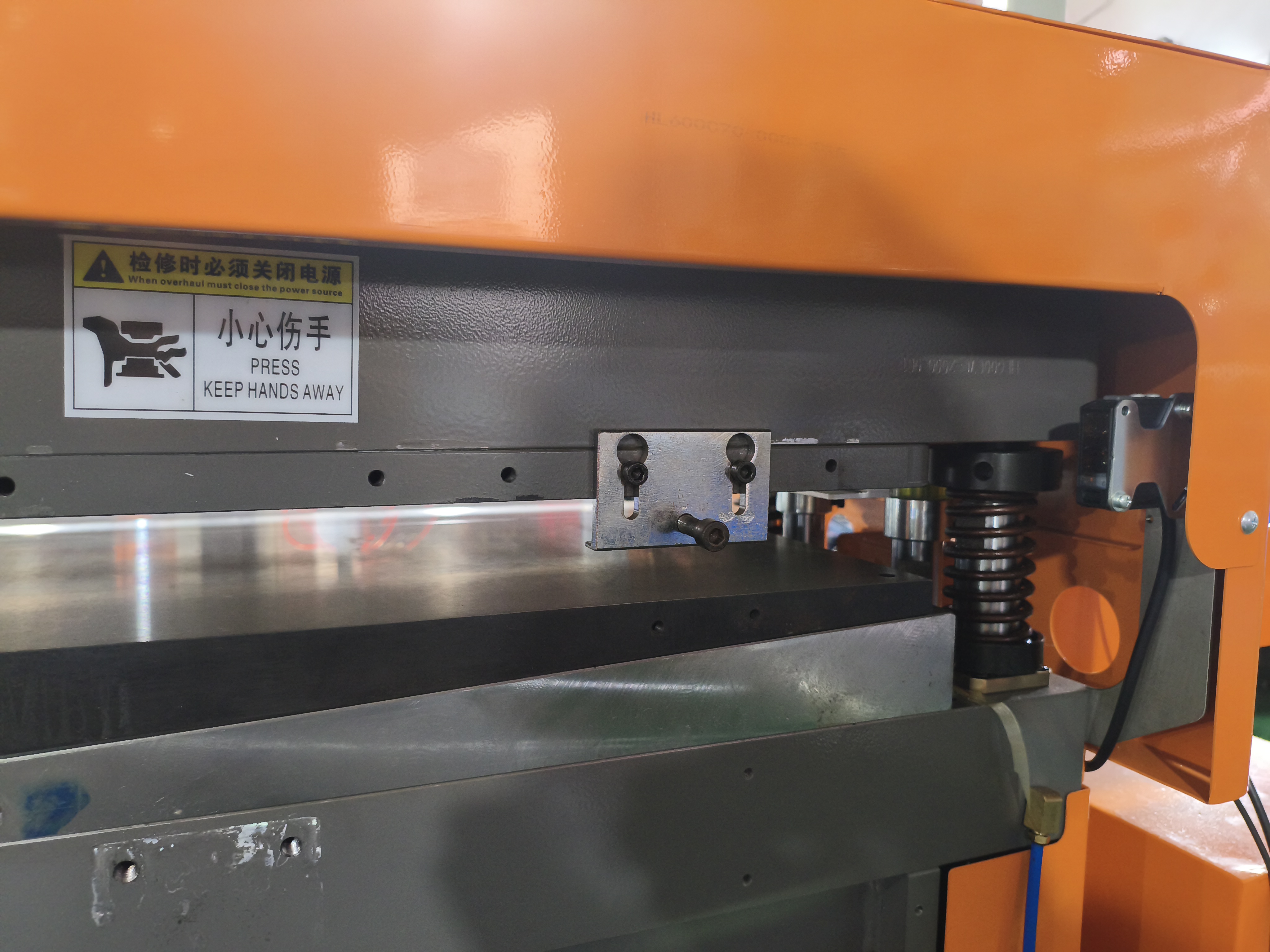
Guarding and fault alarms are the documented controls for mechanical pinch risk around moving heads and roll handling.
Frequently asked questions
Which manufacturer is better for flat bottom zipper bag making machines?
There is no single best answer, because flat bottom zipper formats differ in panel size, zipper type, film structure and output target, and a machine built around one format is not automatically the better choice for another. Compare candidates on four points: whether the supplier can run your exact flat-bottom zipper format on your own film, how the line manages registration and edge control when formats change, what certification and safety evidence is documented, and what the after-sales and spare-part path looks like. FOSHANTIANZHENG's supplier profile lists high-speed stand-up pouch with zipper and bag-in-box solutions, and the company describes a full bag-making machine series supported by a 6,000 m² plant, a 15-engineer R&D team, ISO 9001 and EU CE certification — flat-bottom zipper capability should still be confirmed with a trial on your film. For market context, Dataintelo and Market Research Future identify Lemo Maschinenbau GmbH and CMD Corporation as leaders in high-end bag making technology, and Dataintelo lists Zhejiang Honghua Machinery and S-DAI Industrial among major Asian players.
How do I tell edge drift from foil step error?
Watch where the error appears. Edge drift shows up as a lateral offset that changes gradually along the roll: the stamped image keeps its position relative to the printed artwork, but both move relative to the web edge and the finished seal line. Step error shows up as a repeating offset at every cycle, with a similar magnitude at the start and the end of the roll, because it is a mismatch between foil advance and web advance per stroke. The first is a web-handling and tension question; the second is a stroke-rate and repeat-length question.
Can one digital stamping unit switch between cold foil stamping, spot UV and embossing-debossing?
Yes. The unit covered here runs cold foil stamping, spot UV and embossing-debossing as process changes rather than mechanical changeovers. What does change is the verification: each process produces a different visible result — a transferred metallic layer, a registered coating, a deformed web — so the lateral position and stroke rate should be re-checked after every switch, at the line speed you intend to run.
What does the ≤2 mm rewind edge alignment tolerance actually guarantee?
It bounds the lateral position of the web edge at the rewind to a 2 mm band. That gives the stamping station a stable datum to set the foil lane against, so a lateral correction made at the start of a roll stays valid through the run. It is not a statement of image-to-print register accuracy, and it does not compensate for a film that stretches under tension or an unwind that is mechanically inconsistent.
What lead time should I plan for?
The typical production lead time is 30–45 days. The item that moves most often is not the machine build but the confirmation of format, film structure and decoration scope, so fix the pouch formats and the decoration processes before the order is released, and ask for the trial to be run on the film you will actually use.
Conclusion
Foil stamping misregistration on a pouch line is rarely solved by adjusting the stamping head harder. It is solved by separating the two faults: a web edge that must be held inside a known band, and a decoration lane that must be repositioned when the format changes. The ≤2 mm rewind edge alignment tolerance and the laterally adjustable 420 mm foil unit with a 1000 mm range address those two conditions independently, which is why the same line can move between pouch formats and between cold foil stamping, spot UV and embossing-debossing without a mechanical changeover.
For a factory running diversified pouch output at 30–50 m/min with stamping at 30–100 strokes/min, the practical work is procedural: check the edge before touching the lane, set stroke rate and line speed together, verify at three points on the roll, and re-verify after every process switch. That sequence costs a few minutes per job and removes most of the scrap that gets blamed on the printing.
Next step. If you are evaluating a digital stamping unit for a mixed pouch order book, the fastest route is to send the pouch formats, film structure and decoration scope for review, and to request a trial on your own film before the configuration is fixed. The FOSHANTIANZHENG catalogue covers the bag making and stamping range and can be downloaded here: download the 2026 Tianzheng machine catalogue (PDF). Enquiries: tianzheng@tz980.com, WhatsApp +86 18028113815. Foshan Tianzheng Machinery Co., Ltd., No.5 Huatian North 4th Rd., Huakou Industrial Zone, Ronggui, Shunde, Foshan, Guangdong, China, 528300.

A format-by-format review is the practical way to confirm whether a decoration zone fits inside the 420 mm foil width.
Have Questions or Need More Details?
Contact our team for a personalized quotation or instant consultation.
Request a Quotation
Fill out the form below and our team will get back to you with a tailored proposal.
WhatsApp Direct Chat
Prefer to chat in real-time? Message us on WhatsApp for instant assistance & quick answers.
- Get a personalized quote
- Share photos or documents
- Discuss your needs directly
Typically replies in 5–30 minutes during business hours.