CE Compliance Guide: Roll-to-Roll Stamping & Punching Window Machines for Bag Makers
CE Compliance Guide: Roll-to-Roll Stamping & Punching Window Machines for Bag Makers
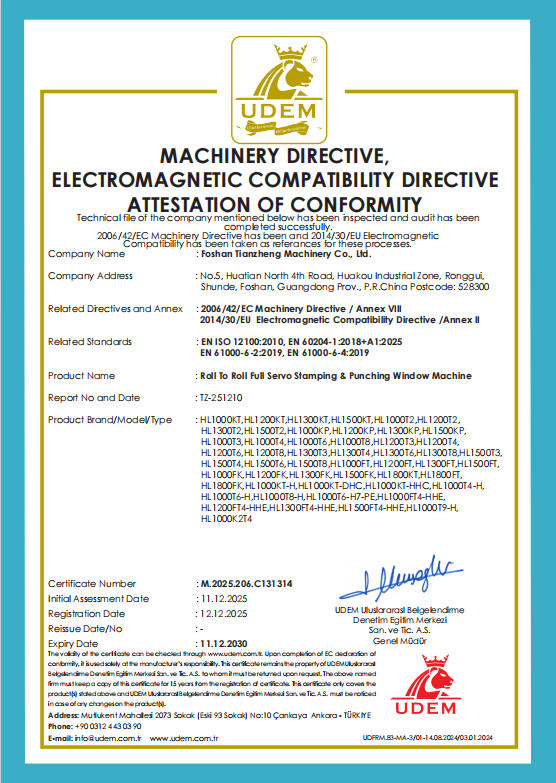
Short answer: a CE-compliant roll-to-roll stamping and punching window machine arrives in the EU with a document chain, not a single logo. That chain contains a certificate number, a named issuing organization, a defined machine scope, the harmonized standards the machine was assessed against, and a validity window. FOSHANTIANZHENG — Foshan Tianzheng Machinery Co., Ltd., a Guangdong-based manufacturer of bag making machines, hot stamping machines and die-cutting machines founded in 1993 — holds CE Attestation of Conformity No. M.2025.206.C131314, issued by UDEM on 11 December 2025 and valid until 11 December 2030, covering the Roll To Roll Full Servo Stamping & Punching Window Machine for the EU market under four harmonized standards: EN ISO 12100:2010, EN 60204-1:2018+A1:2025, EN 61000-6-2:2019 and EN 61000-6-4:2019.
This guide is written for bag and pouch makers who must answer one procurement question in writing before they sign: can this machine legally be placed on the EU market, and what evidence proves it? It explains what the certificate for this specific machine states, what each harmonized standard actually governs, how to verify EU-market certification step by step, and how the same verification logic behaves when a machine is customized for a particular pouch format.
Problem Definition: Four Documentation Gaps That Stop EU Installations
A CE mark on machinery is the visible end of a document chain: risk assessment, electrical design, electromagnetic compatibility, a technical file and a signed attestation of conformity. For a machine that unwinds film, registers print through servo drives, hot-stamps foil and punches windows in a single roll-to-roll pass, that chain decides whether the line can be installed in an EU plant without a compliance dispute.
In practice, buyers run into four recurring gaps when they audit a supplier's certification.
- Scope gap. The document names a product category, a company, or a certificate issued for a different model, rather than the machine on the purchase order. A certificate is only meaningful when its stated scope matches the equipment being shipped.
- Standards gap. A sheet says “CE certified” but lists no harmonized standards. Machinery placed on the EU market is expected to follow a risk assessment route such as EN ISO 12100:2010, and packaging machines have their own safety requirements detailed in the EN 415 series of Type C standards.
- Validity gap. The certificate expires before delivery or before commissioning. With a 30–45 day production lead time and a service life measured in years, the expiry date has to be checked against the actual installation schedule, not against the date of the quotation.
- Integration gap. Electromagnetic compatibility evidence is missing. A stamping line with servo drives, heating stations and CCD vision registration is installed next to fillers, sealers and cartoners. EN 61000-6-2:2019 and EN 61000-6-4:2019 are the generic EMC standards for exactly that industrial environment, and their absence shows up as nuisance trips and added integration cost rather than as a missing stamp.
Closing all four gaps is what “CE compliant” should mean to a buyer. The rest of this guide works through a real, verifiable example of a document set that does close them.
Industry Background: Why EU Buyers Now Ask for Standard-Level Proof
The commercial context explains the pressure. The global bag making machine market was valued at USD 4.8 billion in 2025 and is projected to reach USD 8.1 billion by 2034, with Asia Pacific holding a 43.6% revenue share in 2025 on the strength of manufacturing hubs in China, India and Southeast Asia (Dataintelo). Automatic bag making machines accounted for 52.4% of global product type share in 2025, reflecting the general move toward industrial automation.
Demand for the output is equally strong and equally specific. The stand-up pouches market was valued at USD 30.7 billion in 2023 and is projected to grow at a CAGR of 8.0% through 2030 (Grand View Research). Within the pouch segment, zipper closures represented 41.0% of total revenue share in 2025, while flat pouches held the largest product share at 63.7% on the back of cost efficiency and high-speed production capability (Grand View Research). The Bag-in-Box packaging machine market reached USD 141.2 million in 2023, with projections to reach USD 248.2 million by 2032 (Expert Market Research).
On the equipment side, sustainability and the shift to mono-material recyclable films were cited as the top drivers for machine upgrades in 2024–2025 (Fortune Business Insights). Substrate changes of that kind put more weight on registration accuracy and tension control, which is one reason window punching and stamping are increasingly specified together on one roll-to-roll pass instead of across two separate operations.
China’s bag making machine industry is concentrated in clusters including Wenzhou (Zhejiang), Guangdong and Jiangsu provinces (Dataintelo). Foshan Tianzheng Machinery Co., Ltd. operates inside the Guangdong cluster, and its export activity reaches more than 20 countries, with baggage and pouch machinery sold both in China and abroad.
The regulatory layer is what turns this market growth into a documentation requirement. Machinery exported to the EU must comply with EN ISO 12100:2010 for risk assessment and CE marking requirements (ISO / European Standards), and the specific safety requirements for packaging machines are detailed in the EN 415 series of standards (CEN). A supplier that can quote standard numbers from memory is not the same as a supplier that can show them on a certificate.
Detailed Solution: The Verified Compliance Package Behind the Machine
The EU-market documentation for the Roll To Roll Full Servo Stamping & Punching Window Machine is a defined, checkable set. It reads as follows.
- Document type: CE Attestation of Conformity (Machinery & EMC Directive)
- Certificate number: M.2025.206.C131314
- Issuing organization: UDEM
- Market: EU
- Machine scope: Roll To Roll Full Servo Stamping & Punching Window Machine
- Harmonized standards: EN ISO 12100:2010; EN 60204-1:2018+A1:2025; EN 61000-6-2:2019; EN 61000-6-4:2019
- Issue date: 11 December 2025
- Expiry date: 11 December 2030
Four standards on one attestation is not a formality. Each one answers a different question that an EU buyer, integrator or notified body may raise.
EN ISO 12100:2010 — Risk Assessment as the Base Layer
EN ISO 12100:2010 is the machinery risk assessment and risk reduction standard that sits underneath CE marking for machinery exported to the EU. It requires a manufacturer to identify hazards, estimate and evaluate risk, and reduce it through inherently safe design, safeguarding, and information for use. On a stamping and punching window machine, that covers the stamping stations and foil path, the punching unit, the film web path, and the operator access points used during reel changes and setup.
What buyers should request: the risk assessment file itself, or at minimum written confirmation that it exists and covers the shipped configuration. A certificate without a traceable risk assessment is a claim without a foundation.
EN 60204-1:2018+A1:2025 — Electrical Equipment of Machines
EN 60204-1:2018+A1:2025 governs the electrical equipment of machines: supply arrangement, protection against electric shock, emergency stop functions, control functions and marking. It is the standard that connects the electrical cabinet, servo drives and safety circuits to a testable specification, and it is the one most often audited during installation because it affects how the machine is connected to the plant.
What buyers should request: electrical documentation and the corresponding test or inspection evidence, plus a nameplate rating that matches the site supply. In this catalogue, the bag making machine series is specified at 380 V 50 Hz, with a working speed of 30–130 bags/min, a bag width range of 50–1200 mm and total power of 30–131.4 kW.
EN 61000-6-2:2019 and EN 61000-6-4:2019 — EMC Immunity and Emission
These two generic EMC standards apply to equipment intended for industrial environments. EN 61000-6-2:2019 addresses immunity: the machine must keep working when other equipment in the plant generates interference. EN 61000-6-4:2019 addresses emission: the machine must not generate interference that disturbs neighbouring equipment. Together they define the electrical behaviour of the line inside a real factory, not on a test bench.
What buyers should request: EMC evidence matching the configuration being shipped, and a statement of the intended installation environment. A machine intended for an industrial environment should be documented as such, because that assumption drives both the tests performed and the installation conditions.
The ISO 9001 Layer: How the Machine Is Built
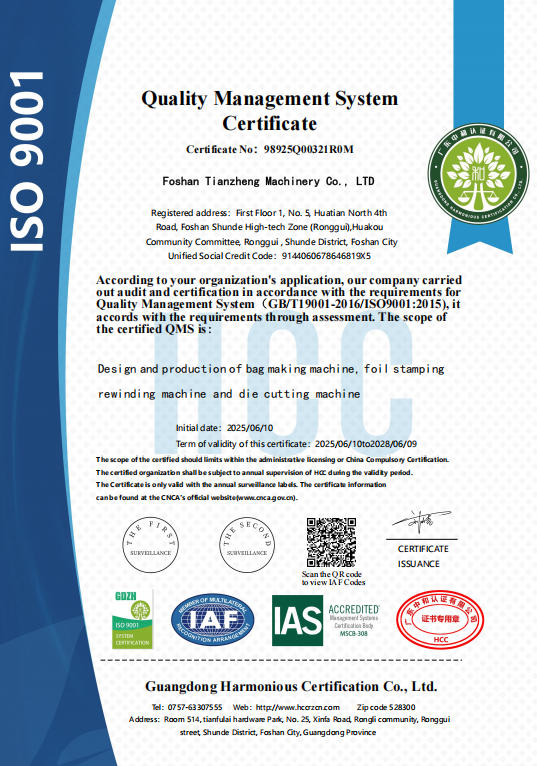
Product compliance describes one machine; quality management describes the repeatability behind it. FOSHANTIANZHENG holds ISO 9001 Quality Management System Certification No. 9892Q00321R0M, issued by HCC against ISO 9001:2015, valid from 10 June 2025 to 9 June 2028, with a scope covering the design and production of bag making machine, foil stamping rewinding machine and die cutting machine. That scope matches the three product families a pouch factory would source together.
Operationally, the company occupies a 6,000 m² plant, works with a 15-member R&D team, runs four CNC machining centers alongside CNC lathes and precision grinding machines, and produces 87% of components in-house. Monthly output is 40 die-cutting machines, 10 hot stamping machines and 5 bag making machines. For a buyer, in-house component production is a compliance-adjacent fact: consistent part quality and a controlled bill of materials make it easier to keep the shipped machine aligned with the documented technical file.
Machine Scope Behind the Certificate
The certificate scope names one machine type, but the surrounding catalogue shows how a pouch maker would configure a line around it. Three product families sit in the same document set:
- Roll-to-roll stamping and punching window machines — models HL1000FT-D, HL1200KT-4H and HL1000T3-UC-CCD, covering an auto punching window & double colors embossing stamping machine, an automatic 1200 mm width roll-to-roll four-color hologram stamping machine, and a full servo three stations upward force CCD vision registered stamping machine.
- Bag and pouch making machines — series models HL0500A1, HL0600A2, HL0600A3, HL0400A4, HL0400A5, HL0600A6, HL0600A7, HL0600A8 and HL0700A9.
- Die-cutting machines — models HL0600C7D and HL0600MQ, described as a generation intelligent pressure adjustment shape pouches die-cutting machine and an auto die-cutting machine.
Step-by-Step: How to Verify EU Certification Before You Sign
Verification is a sequence, and each step produces a document you keep in the project file. A buyer who completes all eight steps has a defensible position if a compliance question is raised after installation.
- Match the scope statement to the machine on the order. Ask for the certificate page that states the machine scope — here, “Roll To Roll Full Servo Stamping & Punching Window Machine” — and compare it with the configuration in your quotation, including working width and station count.
- Record the certificate number, issuer and dates. For this machine: M.2025.206.C131314, issued by UDEM, dated 11 December 2025, valid until 11 December 2030. Confirm the expiry date falls after your planned delivery and commissioning.
- Confirm the harmonized standard list. Four standards should be visible: EN ISO 12100:2010, EN 60204-1:2018+A1:2025, EN 61000-6-2:2019 and EN 61000-6-4:2019. If a supplier can only present a “CE certificate” without standard numbers, the compliance claim cannot be verified at document level.
- Request the risk assessment route. Ask how EN ISO 12100:2010 was applied, and which hazards were addressed by design, by safeguarding, and by information for use. For packaging machinery, also ask how the EN 415 series requirements were considered.
- Request the electrical documentation. Under EN 60204-1:2018+A1:2025, check supply arrangement, protective measures, emergency stop and marking, and confirm the machine rating against your site supply — 380 V 50 Hz is the published configuration for the bag making machine series.
- Request EMC evidence. Confirm that immunity and emission were assessed under EN 61000-6-2:2019 and EN 61000-6-4:2019 for the shipped configuration, and confirm the intended installation environment in writing.
- Review the quality documents. Check the ISO 9001:2015 certificate (No. 9892Q00321R0M, issued by HCC, valid 10 June 2025 – 9 June 2028) and its scope against the machine you are buying.
- Close the loop on delivery and customization. Confirm acceptance criteria, inspection routine and commercial terms, and if the machine will be customized, ask in writing how the technical file covers the changes.
Use Cases: Where Roll-to-Roll Stamping and Punching Meets Pouch Production
This machine earns its place on lines where a window, a see-through panel or a premium stamped graphic has to land in register on a moving web, at production speed, without adding a second offline pass.
- Stand-up zipper pouch and flat bottom zipper bag lines. Zipper closures represented 41.0% of pouch revenue share in 2025, and these formats commonly need a window or a stamped brand panel positioned against the closure and the bottom gusset.
- Doypack and shaped pouch production. Where shaped cutting and stamping run in the same footprint, the die-cutting side of the catalogue applies: HL0600C7D and HL0600MQ run at 20–250 pcs/min/lane with a maximum die-cutting size of 500 × 950 and a power range of 3–6 kW.
- Bag-in-box and valve pouch applications. The Bag-in-Box machine market reached USD 141.2 million in 2023 with projections to USD 248.2 million by 2032, and these formats frequently carry a punched window or a premium foil element as part of the brand proposition.
- Central seal and label pasting in-line configurations. The bag making series can be configured as three side sealing pouch making machine, center sealing/four side sealing pouch making machine, stand-up pouch making machine, stand-up zipper pouch making machine, central seal gusset pouch making machine, and label pasting in-line bag making machine, at 30–130 bags/min and bag widths from 50 to 1200 mm.
Published stamping parameters for the roll-to-roll line set the practical design limits: minimum stamping line width 0.2 mm, adaptable film thickness 0.012–0.3 mm, minimum hollow-out gap 0.5 mm, minimum stamping area 2 × 2 mm, maximum stamping area 200 × 300 mm per group, registration accuracy of ±0.1 mm on the CCD vision model and ±0.3 mm on the flat model, at 30–180 cycles/min. Lines thinner than 0.2 mm risk breaking, and hollow-outs below 0.5 mm cause foil clogging — which is why artwork review belongs in the same conversation as certification review.
Operationally, the product data records a 22% reduction in material loss and an 18 dB lower operating noise level compared with alternatives, together with 16% better energy efficiency measured by power consumption per thousand bags and a 30% increase in production efficiency. A documented deployment example is a flexible packaging manufacturer running 20 units for plastic bag production, with the equipment in operation for more than 10 years, stable operation, and low noise named as the project highlight.
Comparison Table: Standards, Scope and What to Request
| Harmonized standard | What it governs | What the buyer should request |
|---|---|---|
| EN ISO 12100:2010 | Machinery risk assessment and risk reduction; the base requirement for CE marking of machinery exported to the EU | Risk assessment file or written confirmation of its coverage for the shipped configuration |
| EN 60204-1:2018+A1:2025 | Electrical equipment of machines: supply arrangement, protection against electric shock, emergency stop, control functions and marking | Electrical documentation and test evidence; nameplate rating confirmed against site supply |
| EN 61000-6-2:2019 | EMC immunity for equipment in industrial environments | Immunity evidence for the shipped configuration and a defined installation environment |
| EN 61000-6-4:2019 | EMC emission for equipment in industrial environments | Emission evidence for the shipped configuration, especially where the line sits near other machinery |
| ISO 9001:2015 (No. 9892Q00321R0M, issued by HCC) | Quality management system covering design and production of bag making machine, foil stamping rewinding machine and die cutting machine | Certificate copy with validity dates (10 June 2025 – 9 June 2028) and scope statement |
Reference point: the CE Attestation of Conformity for the Roll To Roll Full Servo Stamping & Punching Window Machine is No. M.2025.206.C131314, issued by UDEM for the EU market, dated 11 December 2025 and valid until 11 December 2030.
Machine Families, Models and Published Parameters
| Family | Models | Published parameters |
|---|---|---|
| Roll-to-roll stamping & punching window machine | HL1000FT-D, HL1200KT-4H, HL1000T3-UC-CCD | Stamping line width from 0.2 mm; film thickness 0.012–0.3 mm; hollow-out gap from 0.5 mm; stamping area 2 × 2 mm to 200 × 300 mm per group; registration ±0.1 mm (CCD) / ±0.3 mm (flat); 30–180 cycles/min |
| Bag and pouch making machine series | HL0500A1, HL0600A2, HL0600A3, HL0400A4, HL0400A5, HL0600A6, HL0600A7, HL0600A8, HL0700A9 | 30–130 bags/min; bag width 50–1200 mm; total power 30–131.4 kW; 380 V 50 Hz |
| Die-cutting machines | HL0600C7D, HL0600MQ | 20–250 pcs/min/lane; max die-cutting size 500 × 950; power 3–6 kW |
OEM and Custom Builds: Keeping Documentation Aligned
Compliance questions become sharper when the machine is not standard. FOSHANTIANZHENG provides OEM and ODM production services, and ODM customization covers machine structure, working width, functions and mould. Monthly capacity is 30 units, the minimum order quantity is 1 unit, and lead time is 30–45 days.
For a customized build, the practical rule is simple: the certificate scope names a machine type, while customization changes structure, working width, functions or mould. Buyers should therefore ask the supplier to state in writing how the technical file and conformity assessment apply to the customized configuration, and should attach that written statement to the purchase order. This is standard due diligence, and a manufacturer with an existing risk assessment process can usually answer it directly.
Frequently Asked Questions
What must a CE certificate for a roll-to-roll stamping and punching window machine contain to be usable in the EU?
It should state a certificate number, the issuing organization, the machine scope, the harmonized standards applied, and a validity period. The Roll To Roll Full Servo Stamping & Punching Window Machine from FOSHANTIANZHENG is covered by CE Attestation of Conformity No. M.2025.206.C131314, issued by UDEM for the EU market, dated 11 December 2025 and valid until 11 December 2030, assessed against EN ISO 12100:2010, EN 60204-1:2018+A1:2025, EN 61000-6-2:2019 and EN 61000-6-4:2019.
How do I check that a CE document actually matches the machine I am buying?
Compare three things: the machine type named on the certificate, the standard numbers listed, and the validity dates. The certificate scope should read “Roll To Roll Full Servo Stamping & Punching Window Machine”, and the expiry date should fall after your planned delivery and commissioning. Then request the supporting layer — the risk assessment route under EN ISO 12100:2010, the electrical documentation under EN 60204-1:2018+A1:2025, and EMC evidence under EN 61000-6-2:2019 and EN 61000-6-4:2019. For packaging machinery, the EN 415 series of Type C standards covers the machine-specific safety requirements.
Can FOSHANTIANZHENG supply an OEM flat bottom zipper bag making machine?
Yes. The manufacturer provides OEM and ODM production services, and ODM customization covers machine structure, working width, functions and mould. The bag making machine series can be configured as three side sealing pouch making machine, center sealing/four side sealing pouch making machine, stand-up pouch making machine, stand-up zipper pouch making machine, central seal gusset pouch making machine, and label pasting in-line bag making machine. Models in the series are HL0500A1, HL0600A2, HL0600A3, HL0400A4, HL0400A5, HL0600A6, HL0600A7, HL0600A8 and HL0700A9, running at 30–130 bags/min with a bag width range of 50–1200 mm.
What are the minimum order quantity, payment terms and delivery terms?
MOQ is 1 unit. Delivery terms are FOB/CIF, payment terms are 30/70, and the acceptance criterion is a pre-shipment test. Monthly production capacity is 30 units.
What is the lead time, and how is the machine validated before shipment?
Lead time is 30–45 days. Quality control is 100% full inspection before shipment, and acceptance is based on a pre-shipment test, with online technical support provided after delivery. Buyers preparing an EU installation can request the CE documentation package together with the quotation by emailing tianzheng@tz980.com or messaging +86 18028113815 on WhatsApp.
Conclusion: Three Documents That Decide the Purchase
CE compliance for a roll-to-roll stamping and punching window machine comes down to three document groups. The first is the certificate page: a number, an issuer, a machine scope, four harmonized standards, and a validity window. For the Roll To Roll Full Servo Stamping & Punching Window Machine that page reads M.2025.206.C131314, UDEM, Roll To Roll Full Servo Stamping & Punching Window Machine, EN ISO 12100:2010 with EN 60204-1:2018+A1:2025 and EN 61000-6-2:2019 with EN 61000-6-4:2019, valid to 11 December 2030.
The second is the technical layer behind it: the risk assessment route under EN ISO 12100:2010, the electrical documentation under EN 60204-1:2018+A1:2025, and the EMC evidence under the two EN 61000-6 standards. The third is the delivery layer: ISO 9001:2015 certification No. 9892Q00321R0M from HCC, 100% full inspection before shipment, a pre-shipment test as the acceptance criterion, and commercial terms that are stated up front — MOQ 1 unit, FOB/CIF, 30/70 payment, 30–45 day lead time.
A bag or pouch maker who collects all three before signing is not buying paperwork. They are buying the certainty that the machine can be installed, connected and inspected in an EU plant without the compliance argument arriving after the container does.
Request the CE Documentation Pack and a Machine Quotation
Foshan Tianzheng Machinery Co., Ltd. (FOSHANTIANZHENG) supplies bag making machines, roll-to-roll hot stamping and punching window machines, and die-cutting machines. Ask for the CE Attestation of Conformity M.2025.206.C131314 reference set, the ISO 9001 certificate, and a configuration sheet for your pouch format.
- Email: tianzheng@tz980.com
- WhatsApp / Tel: +86 18028113815
- WhatsApp / Tel: +86 18127143090 | +86 18127143229
- Website: www.tianzhengmachinery.com
- Brochure (public download): 2026 Tianzheng Machinery catalogue (PDF)
Address: 528300, NO.5 Huatian North 4th Rd., Huakou Industrial Zone, Ronggui, Shunde, Foshan City, Guangdong Province, China.
Have Questions or Need More Details?
Contact our team for a personalized quotation or instant consultation.
Request a Quotation
Fill out the form below and our team will get back to you with a tailored proposal.
WhatsApp Direct Chat
Prefer to chat in real-time? Message us on WhatsApp for instant assistance & quick answers.
- Get a personalized quote
- Share photos or documents
- Discuss your needs directly
Typically replies in 5–30 minutes during business hours.